
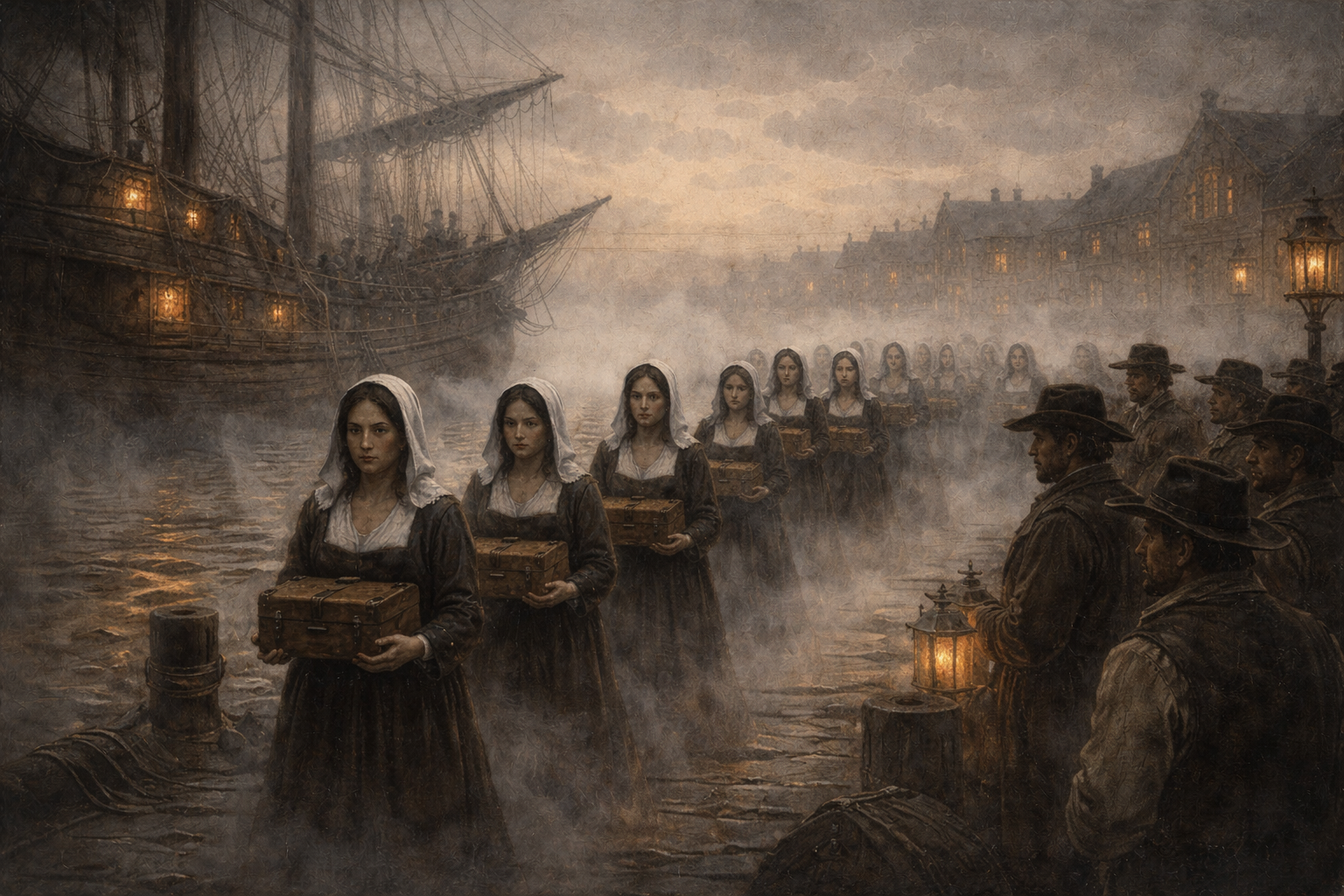
The Casket Girls of New Orleans and the Vampire Legend –
Whispers from the Rivers Edge –
A strangling fog lingers over the black waters of the Mississippi, like pale fingers searching for something lost. Its damp breath bonds apathetically against the skin. The veiled moon struggles against tattered clouds. Holding its position to pierce the darkness, only to be engulfed once more and reduced to a spectral smear.
A faint metallic tang rides the air, mingling with the sour scent of river rot. In the silence something ominous prowls the crisp fall night. Whispers broken only by the low groan of the vessel’s timbers.
The witching hour is well underway as a lone vessel drifts into place. Torchlight’s crackle, casting halos onto the haze, distorting the features of those on board.
At the riverbank, a crowd gathers along the frost-bitten dock, boots scraping on the frozen planks. Men stand shoulder to shoulder.
Their wool coats secured tight. Gloved hands resting in pockets as the bitterness of the frost coaxes heat from their bodies. The cold creeps viciously into their nostrils, forcing them to breathe through parted lips. Frozen air gnawing at their tongues.
A pulsating rhythm pounds within each individual, their own heartbeat resembles a drum summoning fate. They tremble with fear and a desperate hope at the same time.
Tonight, a promise is to be fulfilled. A promise of brides from their distant homeland.
The crew hastily works with anxious perseverance, loading heavy wooden trunks onto waiting carts destined for the Ursaline Convent.
An unspoken uneasiness thickens the air, as if a nocturnal creature encircles, holding its breath, waiting to ambush. Workers are silent, eyes averted, jaws tight, possessing words of warning they dare not speak.
Onlookers notice expressions of concern and fright from the crew. Whispers spread like ocean waves. Fingers purposefully extend toward the dock.
The crowd grows increasingly aware of the laborer’s terror. Smiles fade as excitement gives way to a grim quietness, enveloping all in a heavy shroud.
Cloaked figures disembark. Approaching destiny with each stride. Feverish eagerness escalates while bystanders inspect. Breath trapped in throats.
Flickering torchlight revealed what the darkens strives to obscure—brides of ashen flesh and fragile as moonlight. Specters brushed with radiance not of this world.
Hollow, sunken eyes baring a lifetime of anguish and sorrow, while their crimson lips glistened under the firelight.
Hope transformed to horror. Silence broken by gasps and inaudible exchanges of conversation.
Thunderous reverberation of fleeing footsteps abruptly overwhelms the silence of the night.
The men, who once positioned themselves for a favorable view, now scatter into shadows. Fearful of the nightmare unchained from sleep, free to roam the waking world.
As they flee, silhouettes draped in white deliberately step forward, establishing dominance beyond the shadows. The Ursuline nuns remained despite the supernatural characteristics of their freshly presented charges.
Escorts to a new life, the girls trail behind the creaking wheels of fate. Each comprehending the long journey ends at the convent and a new one begins.
Under the semblance of sponsorship, lodging would be provided until suitable marital matches were offered.
Promptly upon reaching the convent the laborers are quietly directed to deliver the girl’s trunks to the attic for safekeeping. One by one, the burdensome freight was carted to the third floor.
Dragged through narrowing, shadow-choked stairways illuminated only by a solitary candle.
The flame trembling under the threat of the wind. Warped, spectral shadows withered and danced on the walls as if something sinister was watching.
Each trunk bore an unnatural weight, provoking fearful whispers and distressful guesses of the contents. The secrets inside were protected with unyielding deadlocks and the keys were surrendered to the convent upon arrival.
Officially, the trunks were to hold essentials for starting married life, but sinister speculation led to rumors of superstition.
Once settled, the nuns were tasked with selecting suitable bachelors. As matches were made, suitors came to call on the girl’s at the convent.
Soon peculiar occurrences clustered ominously around the convent’s location. In the beginning they were simply whispered away as happenstance. However, as frequent instances increased, suspicion was commanded.
Visitors who crossed the threshold were struck suddenly ill. Their strength fading as though siphoned by unseen hands. A grim surge in casualties followed.
Hushed rumors of pale and bloodless bodies, with mysterious puncture wounds, ignited a spark and fueled a fire. Tales of shadowed figures and faint apparitions stalking the streets of the French Quarter spread like flame to dry timber. Speculation hardened into accusation.
Something unholy crossed the ocean with the brides, feeding beneath the shroud of matrimony.
Responsibility fell upon the Ursuline nuns to implement strict sanctions. They tightened their rule in hopes of silencing the mounting allegations against the girls. Yet rumors intensified, festered in confinement rather than diminishing.
Paramount among them was whispered suspicion surrounding the unnatural weight of the trunks occupying the attic.
Seeking to dispel the gossip, the sisters ascended to inspect the contents. Each trunk contained the same hollow void, an emptiness that felt deeper than mere absence.
Troubled by what was unseen, the nuns resolved to seal the attic entirely, denying entry in or out.
Spaces within the attic are consecrated. Windows and doors fortified. Nails blessed by the Pope secure the shutters.
A divine covenant was affirmed, a binding of earthly evils within the convent’s structure. Protecting the inhabitants below from its ravenous reach.
Despite past efforts from the nuns, this was not the conclusion of the uncertainty.
To this day, gossip endures of nocturnal winds that howl, hurling with violent rage. Forcing themselves into the tiniest crevices of the convent, compelling shutters to open against all restraint.
Hidden secrets revealed, exposing spectral figures pressed to the glass, their hollow gaze fixed upon the external world below. Trapped in ravenous silence.
They yearn to feast upon the very souls of the living who pass beneath the convent’s walls.
Locals who find themselves wandering near the convent deliberately avoid passing directly below its ominous structure. Heeding the cautionary tales and hushed histories that cling to its walls. Choosing instead to cross the street, casting wary glances over their shoulders.
Fearing the convent will notice them and remember their faces.
How the Darkness Took Root –
The legend of the Casket Girls would have one believe it is far more deeply rooted than truth allows. Unearthly origins twisting backward through time, trickling into the modern era. It has been retold in many ways, with various embellishments. But the premises are still the same.
Tour guides still warn the curious, lowering their voices as they recount an urban legend born in the 1970’s.
Two paranormal investigators, drawn by the convent’s dark reputation, parked nearby and were discovered lifeless at daybreak.Their deaths were marked by savage wounds to the neck. Throats torn open with flesh incised as if by multiple sharp instruments striking in unison.
For all the violence there was scarcely any blood to be found at the scene. As though it had been meticulously drained away.
The tale lingers, unsettling and unresolved, a final caution to those who dwell too long in the convent’s shadow.
There are no accounts of a mysterious illness and no documented deaths of victims bled dry. Also, no vampires lurking in the margins of history and no paranormal investigators found with their throats ripped out.
Ink and parchment insist upon reason and silence, and yet, the legend persists. It refuses to die, lingering in the collective imagination like a revenant. Lovers of the mystical are fascinated.
The legend seduces the mind with the dangerous fantasy that, in some dark and forgotten way, it all truly transpired.
Told to visitors as a traditional narrative, the account is embroidered with shadows. Its history enhanced by details that slip beyond authentication.
The tale of the Casket Girls is an obscure legend whispered to tourists as proof of New Orleans supernatural inheritance.
The truth, stripped of its phantoms, is far less sensational, yet remains a vital vein in Louisiana’s living history.
Still, when guided by a skilled storyteller, the legend leaves its mark. Travelers leave uneasy and watchful. Glancing over their shoulders, scanning doorways and alleys for shadows that are stirring in the dark.
The legend seems to draw first breath in the early twentieth century. Conjured to cast a darker spell over New Orleans and lure the curious into its haunted embrace. It is far more plausible that an unearthed historical record led to a sinister depiction.
The program “filles à la casquette”, which translates to “Girls with Suitcases”, was a valid undertaking. In a fatal twist of translation, the French word “casquette” was misinterpreted for casket.
From that single misstep, the image of a coffin took hold. Summoning visions of death, burial, and the occult. One translation error birthed a legend, binding the city’s past to a supernatural mythology that still refuses to rest.
By the nineteenth century, New Orleans had already sealed its bond with the supernatural.
The infamous Voodoo Queen Marie Laveau set an ominous backdrop. While the unspeakable atrocities attributed to Delphine LaLaurie were etched into the city’s dark memory, binding horror to history.
At the same time, the imagination of the age was inflamed by vampire tales. Joseph Sheridan Le Fanu’s Carmilla in 1872 and Bram Stoker’s Dracula in 1897. They both introduced the world to a hunger for blood and shadows.
The notion of young women arriving in the colonies bearing coffins ignited a morbid revelation. A perfect spark to inflame tourist’s curiosity.
In an era obsessed with seances, spirit cabinets, and ghostly communications, vampires fit in with that realm. Coaxing them from the darkness and parading them in the lantern light.
New Orleans was already steeped in dread and mystery. This legend did not invent its darkness, it merely sharpened it. Providing yet another seductive layer to the city’s enduring, haunted charm.
The Fire that Ate the Ink –
It would be convenient if every question could be answered by a ledger.
But New Orleans is a city that knows the fire of progress.
On March 21, 1788, flames tore through the young colony. It devoured the parish church, government buildings, and the fragile paper trails of an emerging civilization. Registers of baptism, marriage, and burial. The quiet witnesses to ordinary lives were reduced to ash.
Again, on December 8, 1794, fire returned. What had survived the first inferno was not entirely spared the second. Civil archives, ecclesiastical records, and municipal documents vanish into smoke.
The losses are acknowledged by institutions like the Louisiana State Archives and the Archdiocese of New Orleans. Both of which note the destruction of early church and civil registers during these catastrophic events.
These documents could have revealed the truth. Instead, they were reduced in embers and silenced. Vital accounts vanished, leaving countless lives untraceable and unnamed by history.
To trace any surviving lineage, one would need family records. Rare relics in a city where memory itself had been scorched away.
The Coffin and the Ledger –
Legend would have us believe the Casket Girls were shrouded French specters. Their arrival was silent.
Heavy wooden caskets carried death rather than a dowry.
History, nevertheless, speaks in colder tones. The girls were part of a sanctioned program sponsored by the King of France.
Consisting mostly of soldiers, tradesmen, and convicts the new settlements struggled to grow and prosper. To seed life and order the sponsorship was devised to help populate the colonies.
Similar bridal shipments to Quebec, Mobile, and Biloxi had met with measured success, at least by official records.
The girls, some scarcely more than children and others newly grown, were between the ages of twelve and twenty-five.
Reportedly drawn from convents or orphanages then sent across the ocean to barter youth and hope for survival and security.
- QUEBEC: Between 1663 and 1673, under the distant and unblinking gaze of King Louis XIV, some eight hundred to nine hundred young women were gathered and sent forth under royal decree, known thereafter as the “filles du roi” or “The King’s Daughters”. Before earning passage across the black and restless sea, each girl was required to present a letter of reference from her parish priest, a fragile testament of virtue meant to vouch for her soul. With ink and wax as their only safeguard, they were chosen for the voyage, bound for an uncertain fate in lands where history would remember their arrival long after their voices were lost.
- MOBILE and BILOXI: Similar bridal programs soon followed. Dispatched to Mobile in 1704 and Biloxi in 1719, each venture marked by hardship and quiet desperation. History records that young women boarded a vessel ominously named “La Pèlican”, their fates bound to its creaking hull. They came to be known as the “Pelican Girls”. It seems it was customary to name them after the ships that carried them across the darkened sea.
In truth, they were the first “filles à la casquette” or “Girls with Suitcases”. Early echoes of what would later become the Casket Girls legend, though untouched by vampire infamy.
These early efforts faltered beneath brutal conditions. For these girls, many dreams withered before they ever had a chance to take root.
- NEW ORLEANS: The “filles à la casquette” that arrived in New Orleans have been misnamed and mistranslated. Birthed into the haunted chronicle of the city. When they arrived in 1728, the stories that followed them took darker forms. Some claim the girls emerged from lives already steeped in hardship. Convicts, prostitutes, or souls forged in the grinding weight of poverty. Others insist they were also drawn from orphanages, convents, or hospitals, cloistered and pious before being cast into the unknown. Truth blurs beneath the layers of rumor. Now the city remembers them not as they were, but as the night reshaped them. As figures forever bound to New Orleans’ shadowed past.
LEGEND contends the Casket girls of 1728 stepped ashore in New Orleans fully formed from mist and myth.
HISTORY, however, speaks in fractured whispers. Records falter, and the precise place of their landing remains obscured. Some accounts suggest the girls were first delivered to Biloxi.
From here they were gathered under the watchful presence of the Ursuline nuns. Escorts for their final, fateful journey to New Orleans—an arrival shaped as much by shadow and silence as by truth.
LEGEND whispers that the Casket Girls arrived bearing coffin-shaped chests. The weight was unnaturally heavy as though burdened with more than wood and iron.
HISTORY tells a quieter, less sinister tale that the “casquettes” were no larger than simple suitcases. They were easily carried by each girl, holding only their modest possessions and the few necessities to start married life.
Between these two truths, one in shadow the other in ink, the imagination of New Orleans chose the darker path.
LEGEND insists the Casket Girls arrived in a ghostly procession. Skin pale as grave ash, eyes hollowed by hunger, crimson staining their lips as though fresh from some unspeakable feast.
HISTORY, far less romantic and far crueler, offers another explanation. The voyage from France to the New World was long and brutal. Stretches of three to four relentless months upon an unforgiving sea.
The girls were often confined below deck. Hidden from the sun by superstition that deemed women ill omens aboard seafaring vessels.
Starved of light, their flesh blanched; plagued by sickness, their bodies betrayed them. Scurvy gnawed at their strength, bleeding gums, deep bruises, and wounds that refused to heal, marking their suffering.
Surrounded by a crew of many men and forced to live below deck for months on end were contributors.
Neglect and trauma seem to be possible causes. When they finally disembarked, they did not resemble monsters but survivors. Bearing the scars of a journey that history records but legend reshapes into horror.
LEGEND claims the Casket Girls were sheltered within the solemn walls of the Ursuline Convent. Watched over by the nuns as though hidden from the world.
HISTORY fractures that image. The Ursuline nuns had arrived only the prior year, and the first convent would not rise until 1734. The imposing structure enshrined in legend would not be completed until 1751. Some accounts suggest the girls were lodged in the homes of colonists.
Others whisper they were kept in crude wooden buildings erected on the same ground until construction was completed.
For seven long years the first convent waited to claw its way from the earth.
By all reckoning, no convent yet stood to accept them when the girls arrived in 1728. And yet the stories persist that the nuns kept the girls close.
Guarding their trunks with almost reverent vigilance. Protecting whatever lay within, or whatever the girls themselves carried, from being exposed by prying eyes and fearful tongues.
LEGEND spins a darker thread still. Once the girls reached the convent grounds, their ominous trunks were carried to the attic. This was done promptly, as if summoned by some unspoken command.
Some tales say the shutters were already sealed. Hammered shut with silver nails said to be blessed by the Pope himself. Others claim the sealing came later, when strange, inexplicable disturbances began to fester in the streets rounding the convent.
Either way, the attic door was locked with grim finality. An act meant to defy death’s advance and bar it from descending.
As if the nuns themselves had foreseen what sought to rise within.
HISTORY, once again, resists the tale. The Ursuline sisters did indeed shelter the girls, but not within the convent we know today. The myth of sealed shutters and a forbidden third-floor attic did not originate from a holy attempt to imprison vampires. Nor was it to deny them sustenance.
The shutters were nailed closed for reasons long forgotten, or left so deliberately, to keep the legend breathing.
One legendary tale states that when the convent was finally completed, the trunks from 1728 were transported openly.
This happened during a festival honoring the dead. The sight was unmistakable.
Carriages bearing coffin-like chests paraded through the streets. The nuns rode within, or walked, solemnly alongside them.
They appeared as though escorting the past itself to its final resting place.
LEGEND murmurs of an incident in the 1970’s leading to two paranormal investigators meeting a brutal end.
A late-night vigil outside the convent resulted in a fatal outcome. Both discovered with their throats torn open as if by something ancient and ravenous.
HISTORY offers only silence. No records, no reports, no trace that such a night ever unfolded. The tale lingers nonetheless. A carefully cultivated urban myth. Born not of fact but of fascination. Fashioned to feed the city’s appetite for darkness and draw the curious ever closer to its haunted gates.
What the River Keeps and What It Does Not –
In the end, the legend of the Casket Girls yields more shadows than certainty. Questions layered upon questions, destined to remain unanswered.
Though history suggests the tale was shaped more by invention than truth, uneasy doubts still linger in the margins.
Were the girl’s willing sacrifices, fleeing hunger and despair in exchange for the fragile promise of a better life?
Did they offer themselves to keep some hidden hunger appeased? Preserving the crew and sparing the world tales of ghost ships drifting chaotically into harbor?
Or were the girls themselves the monsters of legend? Vampires concealed in plain sight, their heavy wooden boxes true caskets filled with soil from their ancestral graves.
Did the Ursuline nuns play a far more sinister role than protectors of virtue?

The great fire that consumed church and civil records feels, to some, like a cruel convenience. Ashes swallowing proof and severing bloodlines beyond recovery.
Was the blaze accidental or a deliberate erasure meant to conceal a darker truth?
Was France seeking to rid itself of a growing vampire presence by sending them across the sea?
If so, did the King’s other sponsored programs serve the same unspoken purpose? A quiet dispersal of the undead into the New World.
Perhaps, no unusual deaths were ever recorded because there were no survivors left to record them, only transformations.
In the silence left behind, the legend endures. Not as a relic of the past, but as a question that refuses to die.
Documents Unearthed –
What the Records Reveal
Beneath rumor, beneath the shutters, beneath centuries of retelling – ink remains.
The arrival of the so-called “Casket Girls” in 1728 is preserved not in superstition, but in colonial documentation. Passenger lists and correspondence housed within the Archives national’s d’être-mer record the transport of marriageable women. Part of France’s effort to stabilize and populate its Louisiana colony.
Historical references confirm that approximately 88 women arrived in 1728. They were sent under royal authority to marry French settlers in New Orleans.
Letters and colonial administrative records further document that these women were temporarily housed by the Ursuline Convent. Not the current convent building constructed later in 1752, but earlier Ursuline quarters that predated the current structure.
Them term “casket” itself derives not from coffins, but from the small chests they carried. Called “cassette” in French, they were used to transport their belongings.
Marriage records from colonial Louisiana parishes corroborate their integration into the colony as wives, not phantoms.
The great fire of 1788 is documented in Spanish colonial administrative correspondence and later summarized in state archival histories. It destroyed much of New Orleans including the parish church, city hall, government archives and many sacramental and civil registers.
The great fire of 1794 was the second major fire to devastate the city. It destroyed additional civil building and parishes. As well as ecclesiastical and municipal records.
Sources of reference can be found below:
- Louisiana State Archives
- Archdiocese of New Orleans
- The Historic New Orleans Collection
- Records preserved in the Archives nationals d’être-mer.
These institutions explicitly acknowledge that early church and civil records were lost in the 1788 and 1794 fires. Many records were also severely damaged during these events.
