
The Trial –
A lowly cleric slips through the vastness of the basilica. He is scarcely more than a ripple in the immense darkness. One by one, he moves along the nave, bringing life to once extinguished torches set ablaze again by flame. Each catches slowly, then blooms into fire, as if awakened from a long, uneasy sleep.
Light crawls up the stone walls, revealing carved saints and hollow-eyed angels who seem to watch in silent judgment.
He then kindles the censers.
Incense begins to burn. It fills the air with a blend of myrrh, frankincense, and rosemary. These fragrances permeate his nostrils with their sharp, sacred aromas.
The smoke blooms thick and pale, curling upward like a restless spirit denied its grave. It lingers, heavy and clinging, veiling the air until breath itself feels borrowed.
Within the haze, phantoms begin to move. They stretch and recoil across the columns. Slipping in and out of the basilica’s darkest corners, granting the illusion that unseen specters have gathered to watch.
Stone saints seem to lean forward. Faces emerge, vanish, and return altered.
The smoke dances. The darkness listens.
With the chamber prepared, the air grows heavy with scent and omen. The basilica is no longer merely lit. It is awakened, ready for the sinister spectacle soon to unfold.
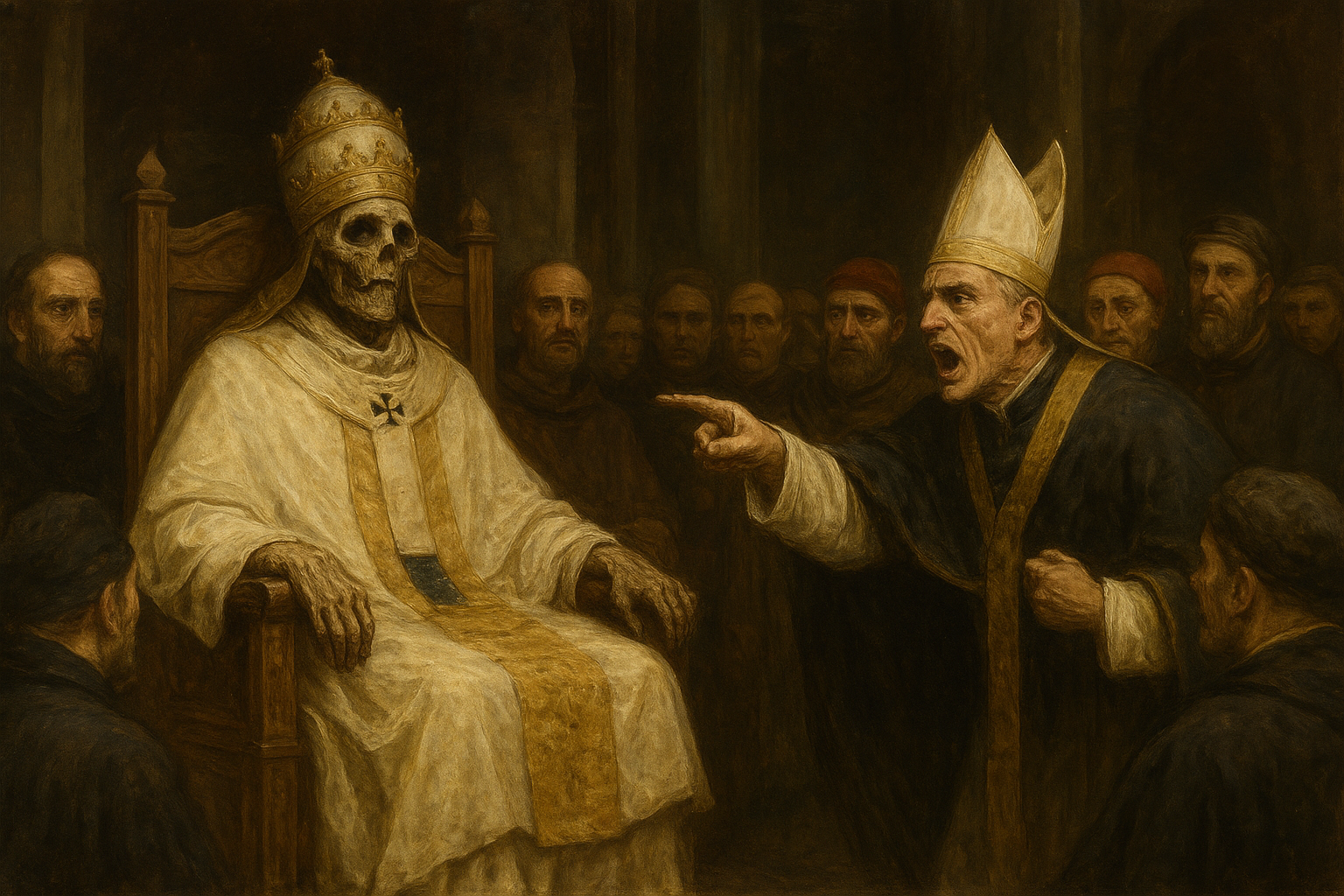
A decomposing body sits enthroned in a solitary chair. This chair is set like an altar to blasphemy at the heart of the chamber. It is propped upright by unseen hands.
Swaddled in papal robes that hang heavy and lifeless, their sacred silk incapable of disguising the ruin beneath.
Eyes that once brimmed with command and conviction are now dark and hollow. Empty sockets drinking in the torchlight without reflection or mercy.
The warmth of living flesh has long fled. In its place is the chill of cured leather skin, stretched tight and clinging to the ridged architecture of bone.
The body does not rest; it endures.
The lips have shriveled and withdrawn, fixed into a grotesque curve misidentified as a smile or a warning. It is the mouth of a man who will never speak again.
Yet seems to hoard secrets even in death, as if the grave itself couldn’t loosen his grip on truth.
Still. Silent. Watching.
The corpse sits not as a relic, but as an accusation. An unholy illusion of authority preserved long enough to be judged, long enough to be damned.
High-ranking members of the clergy drift into the chamber one by one. Their vestments whispering against the stone as they take their places within the smoke-choked air.
Each man carries a small defense against what awaits them. Handkerchiefs soaked in incense, or tight bundles of crushed flowers, clenched like talismans in trembling hands.
They raise them to their faces, breathing through fabric and petals, yet the effort is futile. Beneath the holy perfumes lurks the sickening, sour–sweet stench of decay, seeping through every attempt at concealment.
It clings to their throats, coats their tongues, and settles deep in the lungs.
Eyes water. Faces blanch. Some avert their gaze. Others stare too long, as if daring the horror to blink first. The incense and blossoms do not banish the smell; they merely mock it.
A fragile veil drawn over corruption too old and too powerful to be hidden.
What Hell is This –
Is this a solemn rite meant to honor a predecessor, or some secret burial ritual whispered only among the faithful?
Neither.
The room fills not only with smoke, but with dread, as the living gather to condemn the dead.
The former pope has received his last rites. He has already been lowered into consecrated earth, sealed within the Basilica of St. John Lateran, where he has lain for nine months, surrendered to silence and decay.
His vigil was meant to be finished.
And yet, here he sits.
He has been exhumed, enthroned, and dragged back from the sanctity of death. He occupies the apex of the chamber. It is as though life itself has been forced to yield him a seat.
The living avert their eyes, while the dead command their attention.
He is no longer a man. He is not a memory either. He has become something far more profane: a corpse summoned to answer for sins the grave was supposed to erase.
Why has he been returned to the world of breath and judgment?
Why does the dead pope now preside, silent and rotting, over the living?
The answer hangs in the smoke-filled air, unspoken and dreadful. This is not remembrance; it is an accusation.
Choices thread themselves through everyday life. Some are born of instinct, others of habit, still others are weighed down by long, agonizing deliberation. Most are buried with us when we finally loosen our grip on breath and bone.
But imagine a choice so grave that death itself refuses to seal it away.
Imagine that a decision made while your heart still beat led not to arbitration in heaven. Instead, it led to the violation of your grave. Your corpse torn from consecrated earth and dragged back into the world of the living.
Not for integrity. Not for truth. But for revenge, humiliation, and the deliberate erasure of your legacy.
This is the Cadaver Synod.
Also called the Cadaver Trial.
A court convened not for the living, but for Pope Formosus I. He is seated in death before a jury of his peers.
He does not rise. He does not speak. His defense is offered by an “advocate” he did not choose, a trembling mouthpiece answering questions meant for rotting lips.
The dead pope sits in silence as accusations rain down upon his remains. Condemned not merely as a man, but as a memory that must be destroyed.
In this chamber, even death is not an escape.
What follows is an account of the Cadaver Synod. Preserved not by legend, but by the cold and unforgiving hand of history.
It recounts the events that led to the desecration of a pope. A grotesque verdict passed upon it and the chain of consequences.
Consequences unleashed by favoring one powerful family over another in Rome’s volatile age.
This was Rome in the long, rotting twilight between the mid-ninth and tenth centuries.
A city where the papal throne changed hands with terrifying speed. Succession advanced by natural death or whispered murder, often before the incense of the last funeral had cleared.
Power did not pass openly. It was conspired in darkened halls, traded among Roman noble families whose loyalties shifted like smoke.
In this era, pontiffs were not merely shepherds of souls. They were pieces on a political board, raised and removed at the will of unseen hands.
And when alliances fractured, even the sanctity of the grave could be violated.
The Cadaver Synod stands as the darkest testament to that age. It is proof that in Rome, faith yielded to ambition. Even the dead could be summoned to answer for the sins of the living.
In 896 CE, Pope Stephen VI was elected. This set into motion one of the most grotesque spectacles ever sanctioned by the church. From his ascension flowed an obscure and blasphemous trial. Not of the living but of Pope Formosus I, long since claimed by the grave.
The crime was not heresy, nor sin, but humiliation.
Pope Formosus I had dared to wound the pride of the Spoletan dynasty. He placed the imperial crown upon Arnulf of Carinthia. Arnulf was the heir of the Carolingian bloodline.
Pope Formosus I proclaimed Arnulf as Holy Roman Emperor. In a single act, Pope Formosus I stripped the Spoletan’s of legitimacy and power. Casting them aside in full view of Rome.
They never forgave him.
Bitter and vindictive, the Spoletan family nursed their grievance beyond his death, allowing hatred to ferment until it demanded satisfaction. Pope Stephen VI, bound by loyalty and pressure to their will, became the instrument of their revenge.
Thus, in whispered chambers and candlelit corridors, a plan was forged.
Not to restore justice, but to stage it.
A plan to drag a corpse from its tomb. To humiliate the dead. To correct what the living believed was an unforgivable injustice.
Why did the Spoletan family harbor such consuming bitterness? Because the papacy itself had become a battleground.
Rome stood trapped between two rival dynasties, the Carolingian’s and the Spoletan’s. Each clawing for divine sanction, each demanding the blessing that only the pope could bestow.
The papal throne was no longer merely sacred. It was a weapon and whoever controlled it ruled not only souls, but crowns.
When Pope Formosus I chose the Carolingian claimant, he did more than make a political decision; he anointed an enemy.
To the Spoletan’s, this was betrayal carved in gold and oil. A public declaration that their bloodline was unworthy of empire. Their authority was stripped, their ambition mocked before all of Christendom.
Such an insult could not be buried with the man who delivered it.
It festered and consumed.
In an age when power outweighed piety, the Spoletans made a resolution. If the living pope would not answer for his treachery, then the dead one would.
A Tale of Two Rival Families –
The Spoletan’s were an Italian noble house. They were rooted deep in the soil of the peninsula. Their power was drawn from swords, fortresses, and blood-bound loyalty. To them, the papacy was not merely sacred; it was a lever of dominion.
Contemporary voices whisper that the Dukes of Spoleto saw the Holy See as a tool to be seized. It was viewed as a crown of prayers and oil. Through it, emperors could be made or unmade. Control the pope, and Rome itself would bend the knee.
Opposing them stood the Carolingian’s, a Frankish dynasty whose lineage traced back to Charlemagne, the giant of a fallen age.
Sometime in 800’s CE, Pope Leo III placed the imperial crown upon Charlemagne’s head, proclaiming him Emperor of the Romans. With that single, sanctified gesture, the Carolingian’s claim was sealed not by steel alone, but by divine authority.
From that moment on, the imperial crown became inseparable from papal blessing. To crown a Carolingian was to affirm their right to rule. To deny them was to invite war, vengeance, and sacrilege.
Thus, Rome trembled between them. Caught in the shadow of Frankish legacy and Italian ambition. The papacy, once shepherd of souls, became the altar upon which empires were sacrificed.
Imperial ambitions gnawed at Rome like a slow, unrelenting rot. For a time, papal favor shifted between the two rival houses. Each blessing sowed the seeds of the subsequent betrayal. Alliances were forged, broken, and reforged in whispers long before steel ever rang.
Political rivalries bled into personal vendettas, and those grudges did not fade with time; they multiplied. One insult begat another. Each slight tipped the first stone in a chain of consequences. These were set in motion years before the dead were summoned to court.
The Cadaver Synod was not an aberration of faith. It was its violation. The synod was a desecration born not of theology, but of ambition and spite. Religion was dragged from the altar and made to kneel before power.
And at the center of this gathering storm sat Pope Formosus I. His corpse enthroned amid the wreckage of feuding dynasties. To understand how the dead came to be judged, we must first trace the living man.
Let us return to the beginning.
FORMOSUS RISE IN THE CHURCH (864-876 CE) –
Unbeknownst to Formosus, the very brilliance that illuminated his rise would one day guide his ruin. His ascent through the ranks of the Church was swift and promising. Yet every step upward cast a longer silhouette behind him.
Along with his true name, little is recorded of his earliest year. As though history itself chose to avert its gaze. Still, it is believed he was born around 816 CE, into a deeply rooted Roman family. One whose standing made clerical advancement possible in an age where sanctity alone was never enough. Power required patronage, and patronage was the currency of Rome.
He was likely educated within the city’s wall. Steeped in Latin and scripture. Disciplined in canon law and ritual worship, shaped from youth for service at the altar and obedience to authority. Such training did not merely prepare men for faith; it prepared them for politics cloaked in holiness.
From the beginning, Formosus stood apart. He possessed an unsettling aptitude. A commanding expressiveness, and a talent for administration.
This drew the eyes of those who measured men not by virtue, but by usefulness. These were the traits most prized in a papal envoy. A man who could speak with conviction, negotiate with kings, and carry Rome beyond its walls.
And so, he was chosen.
And so, he was marked.
BECOMING BISHOP OF PORTO (864 CE) –
In 864 CE, during the reign of Pope Nicholas I, Formosus was elevated to the office of Cardinal Bishop of Porto. A post of rare distinction and dangerous proximity to power. Porto was no ordinary diocese. It stood close to the very heart of papal administration. A seat reserved for those the pope trusted most, and feared least.
From this vantage, Formosus moved ever nearer to the inner sanctum. He became not only a trusted advisor but a papal envoy, carrying Rome’s interests into foreign courts and troubled realms. His words now shaped alliances: his presence bent kings toward obedience or defiance.
Yet such favor is never without consequence.
Whispers followed him through marble corridors and candlelit halls. Some saw not devotion, but ambition, simmering beneath his polished piety. They murmured that his gaze lingered too long on the throne, that his rise was too swift, too specific.
In Rome, trust and suspicion are born together. And Formosus, whether he knew it or not, had begun to gather enemies. Enemies who would one day remember every step he took toward the light.
As a papal legate, Formosus was dispatched beyond Rome. He carried the authority of the Holy See into foreign courts and uneasy kingdoms. It was there, among the Frankish realms, that he forged strong and lasting bonds. Strengthening the alliance between Rome and the Carolingian nobility. His voice was steady, his presence commanding. Too commanding, some would later say.
In Bulgaria, his influence deepened further. King Boris I, captivated by Formosus intellect and authority, petitioned Rome to have him appointed Archbishop of Bulgaria. It was a gesture of extraordinary trust, and a dangerous one. Such a post would have placed immense spiritual and political power in Formosus far beyond the reach of Roman oversight.
The request was refused.
Pope Nicholas I denied it, invoking canon law. A decreed that a bishop may not abandon one diocese to claim another. Yet beneath the legal reasoning lay a more profound fear. That Formosus, once unbound, would become too powerful. A churchman with a kingdom of his own and loyalties no longer tethered to Rome.
The denial did not erase the episode. It lingered like a stain remembered and later twisted into accusation. What had once been evidence of Formosus’ brilliance would be reshaped into proof of his guilt. Another wraith waits patiently for its moment to rise.
RISE TO BE POPE (872-891 CE) –
Formosus’ missions beyond Rome’s borders earned him a reach few Roman bishops ever possessed. In Bulgaria and throughout the Frankish kingdoms, his influence took root, spreading far from the diocese of Porto. Kings listened. Courts welcomed him. His authority traveled faster than his name, and that alone was enough to breed fear.
Such sway was unnatural for a bishop of Rome’s outline. Whispers hardened into accusations, and suspicion curdled into judgment. In 876 CE, Pope John VIII grew wary of Formosus’ growing power and rumored ambition. He struck him down with the Church’s most terrible weapon, excommunication.
Before the eyes of the faithful, Formosus was compelled to swear a humiliating oath. He would never return to Rome, never again perform priestly acts, never raise his voice in the service of God. It was meant to be a spiritual death, a living burial.
Yet Rome is fickle, and power shifts like smoke in a crypt. A few years later, the political air changed. Formosus was restored to his office, welcomed back into the fold as though the curse had never been spoken.
But oaths are not so easily forgotten.
Suspicion lingered like a dark hue upon his name, clinging to him like grave soil beneath polished robes. Waiting for the moment it could be unearthed.
In 882 CE, Rome awoke to blood on sacred stone. Pope John VIII was assassinated. Cut down within the very walls meant to protect him. With his death, the curse he had laid upon Formosus died as well.
His successor, Pope Marinus I, a friend and ally, restored Formosus to the Bishopric of Porto. Formally washing away the mark of exile. The oath was undone, the silence lifted, and the man once banished from Rome returned to its heart.
But the Church he reentered was no longer whole.
From within the papal court, Formosus bore witness to a faith fractured by intrigue, a throne surrounded by daggers and ambition. He saw papal authority tremble, how power shifted not by prayer, but by conspiracy and violence.
As the decade waned, so too did restraint. Formosus’ voice grew stronger, and his counsel was sought more often. By late 880 CE, his voice became a formidable presence within the College of Cardinals. A man whose influence reached far beyond Porto and whose light stretched ever closer to sovereignty.
And in Rome, such prominence was never a blessing without consequence.
On October 6, 891 CE, the bells of Rome tolled for Pope Stephen V. From their echo rose a new and perilous reign. Formosus was elected pope, a seat already slick with blood, betrayal, and unquiet ambition.
The moment the tiara touched his brow, he was ensnared.
His elevation thrust him directly into the smoldering conflict between two merciless powers. The Carolingian’s and the Spoletan’s. One foreign heirs to an imperial legacy who claimed guardianship over Rome. The other, local dukes of Italy who ruled by proximity, steel, and intimidation.
One demanded loyalty sealed by coronation; the other demanded obedience enforced by presence.
Pope Formosus I did not merely inherit the papacy; he inherited a war. Every blessing became a provocation: every silence, a threat.
As he stood between these rival forces, the specters that had followed him since Porto closed in. Waiting for the choice that would seal his fate.
In the earliest days of his pontificate, Pope Formosus I found himself besieged. Not by armies alone, but by the suffocating will of Duke Guy III of Spoleto.
The duke pressed upon the papal throne like an iron hand. Demanding the sacred rite that would cloak his ambition in divine sanction.
Hemmed in by Spoletan power and threatened by their presence in Rome, Pope Formosus I yielded. With reluctance heavy upon his soul, he placed the imperial crown upon Guy III. Then upon his son Lambert naming him co-emperor. The anointing oil fell like a curse rather than a blessing.
With that act, the Spoletan’s tightened their grip. Rome bent beneath their dominance; the city was ruled not by prayer but by fear and proximity. The pope remained enthroned. Yet no longer sovereign. His authority was overshadowed by the very men he had crowned.
And in the dim corridors of the Lateran, it became clear: this submission would not be forgiven, nor forgotten.
Still bound by old loyalties to the Carolingian’s, Pope Formosus I began to weave a quiet counterstrike against the Spoletan domination. Beneath the incense and ritual, plans took shape. Dangerous, treasonous plans meant to loosen the iron grip tightening around Rome.
In 894 CE, he sent his summons north, calling upon Arnulf of Carinthia, the Carolingian king, to descend into Italy. It was an invitation heavy with consequence, a gamble meant to shift the balance of power.
But the Alps rose like a wall of discernment.
Winter closed its jaws around Arnulf’s army as they attempted the crossing. Snow swallowed roads, winds flayed flesh, and the cold turned breath into knives. Supplies thinned. Men fell ill. Others deserted, vanishing into the white silence. The mountains did what armies could not.
Arnulf gained only fragile footholds in northern Italy, victories too shallow to sustain. Lacking strength, plagued by loss, and battered by an unforgiving land, he was forced to retreat. The Spoletan grip remained unbroken, for now.
And Pope Formosus I, having dared to defy them, had only deepened the gloom gathering around his seat.
In 896 CE, the reckoning returned. This time with iron and resolve. Arnulf of Carinthia gathered his strength anew, his forces hardened by failure and sharpened by vengeance. When they crossed the Alps again, they did not falter. The mountains, once executioners, now stood silent as the army descended like a long-delayed curse.
The Spoletan hosts fell before them. One stronghold after another collapsed, their banners trampled into the mud. Arnulf’s advance was relentless, driving south until at last this army stood before the gates of Rome itself.
Within the city’s veined stone and whispering walls, Pope Formosus I waited. Not as a conqueror, but as a man who staked his soul on a final gamble. Arnulf passed through Rome’s gates, not as an invader but as an emancipator.
Rome exhaled, drawing a fragile breath of hope that trembled beneath the gathering darkness of what was yet to come.
On February 22, 896 CE, beneath the darkened vaults of the basilica, Pope Formosus I placed the imperial crown upon Arnulf’s head. The oil flowed. The prayers were spoken. Within trembling hands, the pope proclaimed him emperor.
In that sacred instant, Spoletan power was shattered, and with it, Pope Formosus I sealed his fate.
After his coronation, Arnulf turned his gaze south. Intent on crushing the Spoletan dynasty and tearing Italy from their ravenous political grip. With his crown still fresh upon his brow, he marched toward Spoleto. Determined to finish what steel and prayer had begun.
Then, calamity struck.
As the city drew near, Arnulf was seized by sudden ruin. His body betrayed him without warning. Struck down by paralysis likely the cruel hand of a stroke. The emperor became a living statue, his will trapped within failing flesh. Leadership vanished in an instant.
Without their commander, the army unraveled. Discipline dissolved into fear. The host withdrew northward, retreating like a tide pulled back by an unseen force.
Rome was left defenseless.
Pope Formosus I, once sheltered by imperial might, now stood exposed. Politically isolated and surrounded by enemies who never forgot. The Spoletan’s reclaimed control with merciless speed, tightening their grasp once more.
On April 4, 896 CE, Pope Formosus I died.
Whether claimed by natural causes or silenced by darker hands remains uncertain. History records only that his death came swiftly, and that in Rome, such endings are rarely innocent.
Upon the death of Pope Formosus I, the balance of power in Rome collapsed into darkness. The Spoletan’s surged back like a returning plague, reclaiming the city and tightening their grip upon the papal throne. With their enemies gone and their dominance restored, vengeance no longer needed to hide.
What followed was not justness, but ritualized hatred.
The Cadaver Synod was conceived not as a trial, but as an annihilation. Its purpose was clear: to unmake Pope Formosus I, to strip him of legitimacy even in death. By condemning his rotting body, the Spoletan’s sought to erase every act of his pontificate. To declare his reign a lie.
And above all, to nullify the coronation of Arnulf of Carinthia. To declare that the emperor had never truly been crowned. That the oil had never sanctified him. That Spoletan power had never truly been broken.
So, they summoned the dead to court. Not to hear his defense— but to bury him a second time, in disgrace.
The death of Pope Formosus I did not bring peace to Rome. It tore it open. The city convulsed with riots and unrest, its streets echoing with anger, fear, and rumor. Faith fractured, and authority bled away into chaos.
From this turmoil rose Pope Boniface VI, a frail and fleeting figure whose reign lasted scarcely two weeks. His body, already failing, collapsed beneath the weight of the throne.
Official voices whispered of acute gout, a convenient explanation for a sudden end. Yet in Rome, such endings are rarely accepted at face value. Some murmured that Boniface did not simply die; he was removed, quietly and efficiently, to clear the way.
The throne did not remain empty for long.
Into the void stepped Pope Stephen VI, a man bound tightly, devoutly, to the will of the Spoletan family. Many saw him not as a shepherd, but as a puppet, raised by unseen hands to serve their vengeance.
Where Pope Boniface VI had been weak, Pope Stephen VI was obedient. Where Pope Formosus I had defied them, Pope Stephen VI would obey.
And under his reign, the dead would not be allowed to rest.
And so, the deceitful, vengeful design was set into motion, not to preserve truth, but to erase it. The Spoletan’s sought not merely to punish Pope Formosus I, but to unmake his legacy. To strip it of breath, bone, and memory.
Yet a problem lingered like an unquiet spirit: Pope Formosus I was already dead.
How does one exact vengeance upon a corpse? How does one avenge humiliation when the offender lies silent in the grave?
The answer took shape in whispers and secret candlelit councils. For months, they plotted, their hatred fermenting into ritual. If the living pope could not be judged, then the dead one would be summoned. The grave would be broken. The corpse would answer.
Thus was the Cadaver Synod conceived—a blasphemy dressed as law, a trial engineered for condemnation. And when the moment came, it was not merely imagined but executed with deliberate cruelty.
In Rome, even death was not a refuge from revenge.
In January of 897 CE, the unthinkable was made real. By the command of Pope Stephen VI, the grave of Pope Formosus I was torn open. The sanctity of death was shattered.
From consecrated earth, his corpse was dragged into the light, stripped of rest and dignity alike.
Robed once more in papal vestments, the dead pope was dressed for judgment. Silk and gold hung from a body already claimed by rot, the symbols of authority mocking the ruin beneath. Thus adorned, he was brought before the tribunal, not as a memory, but as an accused.
The charges were read aloud to a body without a voice.
- Perjury – for breaking a sacred oath to Pope John VIII to never return to Rome or exercise priestly functions again.
- Violation of canon law – for presiding over more than one diocese at the same time.
- Usurpation – for attaining the papacy itself by unlawful means.
The trial began not with testimony, but with desecration. The dead were forced to stand before the living. Justice, if it could still be called such, was bent into an instrument of vengeance.
In the end, the Spoletan family declared themselves satisfied. What they called vindication had finally been delivered, not by God, but by revenge sanctified in ceremony.
The papacy of Pope Formosus I was pronounced a lie. His reign was erased with trembling voices and cold decree. Every act he had performed, every blessing, every coronation, every judgment was annulled as though his hands had never touched the holy oil. As though his words had never carried divine weight.
Then came the final humiliation.
His corpse was stripped of its sacred vestments, his dignity torn away along with them. No longer pope, no longer man, he was treated as refuse. The remains were dragged through the streets and cast into the black waters of the Tiber. Surrendered to the current like an unwanted secret.
Thus ended the Spoletan’s revenge. A dead man condemned, a legacy drowned, and a church forever tainted by the knowledge that even the grave could be violated when power demanded it.
THE AFTERMATH –
Rome recoiled in horror.
Citizens and clergy alike were stunned by the outrageous sacrilege, its political stench impossible to disguise. What had been done in the name of justice was revealed for what it truly was, a blasphemy so profound it shook the soul of the city. The streets erupted in riots, faith and fury colliding beneath the watchful eyes of broken saints.
Yet even in fear, loyalty endured.
Those who had loved and honored Pope Formosus I moved in secret. Under the cover of night, they pulled his violated remains from the dark waters of the Tiber, reclaiming what power had tried to erase. His body was reburied quietly, returned at last to consecrated ground.
Soon, whispers spread.
Rumors of miracles at the grave crept through Rome like a half-remembered prayer—healings, visions, and signs that the dead pope was not finished speaking. Whether truth or desperate hope, the stories took hold. And with them came a terrifying possibility. The man condemned in death had been reckoned unjustly, and that heaven itself had taken notice.
The cries for Pope Stephen VI to be removed did not go unanswered. Rome, still reeling from sacrilege and bloodless cruelty, turned its fury inward. The man who had dared to judge the dead was now marked for judgment himself.
Abandoned by the very power that had elevated him, the Spoletan family withdrew their protection. No aid came. No hands reached out. With his usefulness spent, Pope Stephen VI was cast aside like a spent candle.
In the summer of 897 CE, he was seized and thrown into prison. There, in a cell thick with damp and past ghosts, the reckoning finally found him. Strangled in darkness, his reign ended without ceremony, prayer, or mercy.
The Spoletan’s had achieved their aim. Their version of vengeance had been enacted, their enemy humiliated beyond death. And so, they washed their hands of the disgraced pope, leaving him to face the consequences alone, just as they had left Pope Formosus I.
In Rome, power never mourns its servants. It simply discards them when the work is done.
In December 897 CE, amid the lingering stench of sacrilege, Pope Theodore II ascended the shattered throne. His reign was brief. No more than 20 days. He nullified the guilty verdict of the Cadaver Synod, denouncing the trial of the dead as a perversion of faith and law. By his decree, Pope Formosus I was restored. His papacy declared legitimate, his name cleansed of the filth cast upon it by revenge.
The dead was granted peace at last.
Pope Formosus I body was retrieved and reburied in its rightful place, returned to St Peter’s Basilica, where it had rested before the grave was violated and the corpse dragged in for false assessment. The tomb was sealed again, this time with reverence rather than rage.
Though Pope Theodore II’s pontificate passed like a whisper, its echo endured. In a city where power devoured its own, he proved that even in Rome’s darkest hour, the dead could still be vindicated, and the truth, briefly, restored to light.
In 898 CE, Pope John IX rose to confront the lingering specter of blasphemy that haunted Rome. With solemn authority, he reaffirmed the nullity of the Cadaver Synod, condemning the grotesque theater orchestrated by Pope Stephen VI and denouncing his actions as an affront to both law and faith.
John IX went further. He decreed that no corpse would ever again be summoned to judgment, sealing the grave against the ambitions of the living. The dead, at last, were granted sanctuary.
Yet Rome did not heal so easily.
Beneath the veneer of reconditioned order, old loyalties still festered. Factions remained divided; some continued to condemn Pope Formosus I, others clinging to the final absolution pronounced over his restored remains. The synod’s eclipse stretched on, refusing to dissolve.
Thus, the papacy stood exposed, entangled in corruption, riven by instability, shaped as much by vendetta as by virtue. In both the old Rome and the new, the throne was no longer merely sacred; it was a battleground, where even the dead could not escape the politics of the living.