
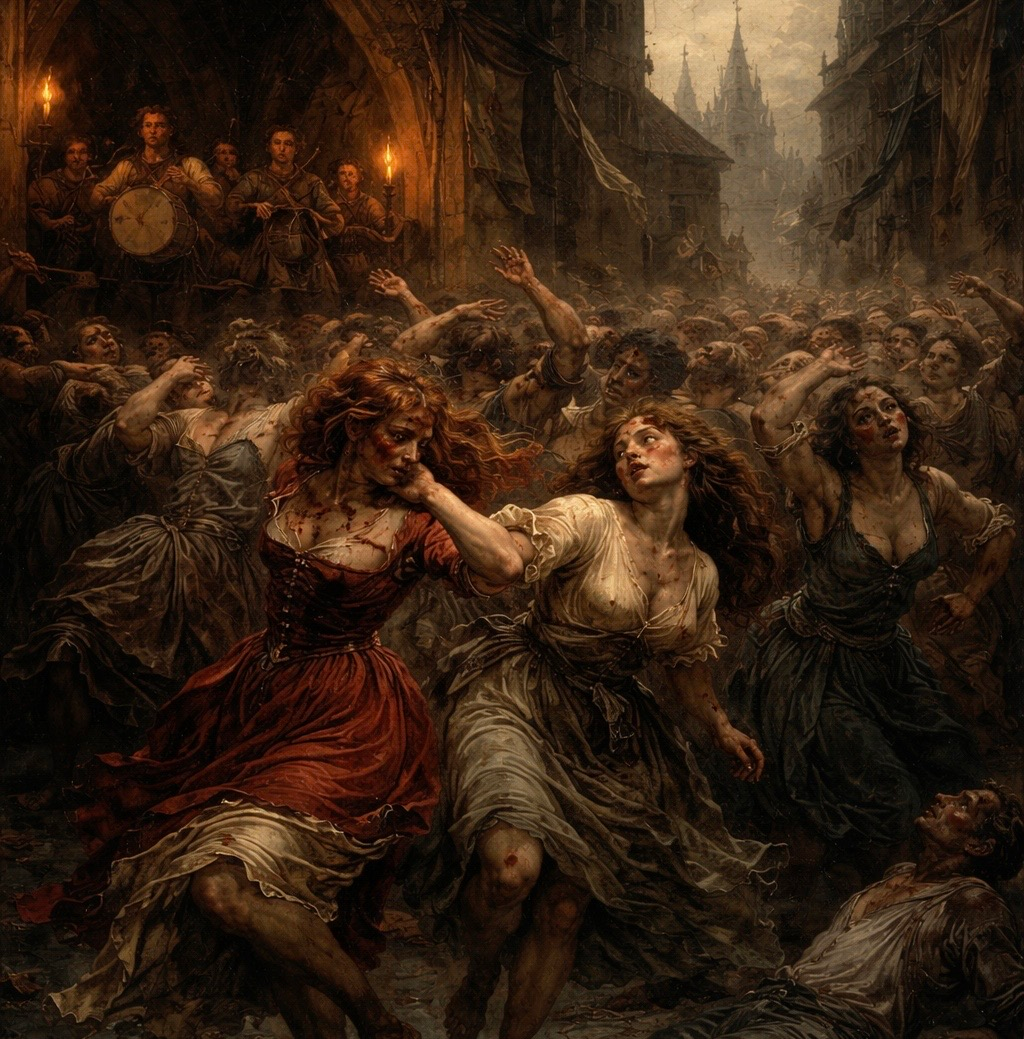
In the summer of 1518, as dusk bled across Strasbourg and the dying sun pressed its final kiss upon the horizon, a plague descended upon the city with merciless fervor.
It did not tear flesh with blade or flame but twisted the body into ruin through a mockery of joy. Bones splintered, feet were flayed raw, and hearts gave out beneath the strain.
These injuries are ones you would expect from crushing labor. They might also result from calamitous falls or the indifferent hand of nature. They are never expected from a tradition meant for celebration.
On the night of July fourteenth, the city’s inhabitants settled into the heavy quiet that follows the evening meal. Lanterns dimmed, prayers murmured, bodies surrendering to the promise of sleep. Frau Troffea stepped into the street. Without music, without warning, she began to dance.
Curious neighbors emerged from their doorways, first amused, then enthralled. They clapped. They laughed. They urged her on, blind to the truth unfolding before them; she could not stop.
Hours bled into days. Frau Troffea’s feet struck the stones until her strength gave way, and her body finally collapsed. By then, it was undeniable. This was no lightness of spirit, no harmless overflow of joy. The cheerful ritual of dance had curdled into something diseased, something malevolent.
By the week’s end, others had joined her. Faces drawn with terror, limbs jerking in obedience to an unseen command. Each afflicted by what the city would come to call a disease.
By summer’s end, at least four hundred souls were claimed. Compelled to dance beyond endurance, they whirled until their hearts failed or their blood vessels burst.
They danced until strokes and sudden death dropped them lifeless upon the streets. Some were spared only when their feet blistered open, when flesh tore and bled too freely to carry them further.
And still, the stones of Strasbourg remembered the rhythm.
With an intense need to keep dancing, they did not stop until they fell from extreme exhaustion. Causing some to have strokes or heart attacks ending fatally. Blisters or feet too bloody to continue finally impeded others.
Physicians whispered of overheated blood, boiled thin by summer’s wrath. A humoral theory was thought to be the source of this strange new affliction. Its contagion showed no pattern, striking without mercy, leaping from body to body like fire through dry timber.
In their fatal wisdom, the learned men prescribed the very act that was killing the city. Dance, they said, would bleed the heat from the veins. Halls were thrown open. Fiddlers were summoned. Fresh, untainted bodies were fed into the rhythm like kindling.
They urged the afflicted to dance the sickness out. Never knowing they were teaching the plague how to spread.
When no mercy came, and the frenzy only deepened, the officials recoiled from their own folly. Dance halls were sealed. Musicians were dismissed in silence. The city itself was stripped of music and communal revelry, forbidden until the turning of the year.
Yet the dancers were not spared. The soundless tempo still ruled them.
With hope abandoned by physicians, the affliction was surrendered to God. What had been named a malady of the body was reborn as a curse of the soul. The tormented were loaded onto wagons.
A journey to a lonely hilltop chapel of Saint Vitus near Saverne, where ritual penance was imposed with desperate devotion.
There, beneath pleading prayers and bloodied feet, they yearned for a celestial miracle. Any sign that heaven still watched, and that the dance might finally release its hold.
The plague loosened its grip only when the tormented were delivered to Saint Vitus. Their bodies broken, their spirits frayed by weeks of relentless motion. There, in supplication and pain, the curse at last began to ebb.
By week’s end the contagion had spent itself. As though whatever unseen force had driven the dance had finally grown sated.
When the end of September arrived, Strasbourg stirred back to life. Streets quiet once more, music absent.
Yet normalcy returned like a wary survivor, never forgetting the rhythm that had nearly claimed them all.
Today, Strasbourg’s most famous plague lingers in silence, its memory buried deep within the catacombs of obscure history.
No bells toll in remembrance. No annual rites honor the afflicted who danced themselves into ruin. It’s as though the city itself has chosen amnesia over mourning.
In 1518, Strasbourg belonged to neither France nor Germany. It stood as part of Alsace, a borderland bound to the Holy Roman Empire. Here where faith ruled daily life and the calamity of the dancing plague was etched into imperial memory, not national legend.
It was not until 1681, when Louis XIV and his armies crushed Alsace beneath the weight of conquest, that Strasbourg was claimed by France.
Now a French city pressed against the German border, Strasbourg bears the mark of both worlds. Its streets speak two cultures, two tongues, and a history divided.
Yet beneath the stones, the forgotten pulse still belongs to the dead who danced when the empire still ruled.
The plague had a name no nation wished to keep.
In truth, the dancing plague of 1518 was little more than a tremor in the vast body of world history. An event too small to reshape empires, yet too grotesque to vanish entirely.
It survived as a footnote etched in ink, preserved only because those who witnessed it could not look away.
The hour of its first awakening, as told in this account, is a fiction born of atmosphere. The chroniclers of the age left no mark of sun or shadow.
Yet the march of days, the spread of bodies, and the grim procession of events were recorded faithfully by those who lived beneath its spell.
What remains, then, is a truth framed by darkness. Details of time may fade, but the dance itself was real and history, however briefly, was forced to watch.
TIMELINE –
Frau Troffea was marked as the first, patient zero, on July fourteenth.
She stepped into a Strasbourg street and surrendered to a dance not of her choosing. Her body moved as if seized by an unseen hand, limbs jerking in relentless obedience, unable to grant itself rest.
No music haunted the thoroughfares. No partner guided her steps. No festival or joy gave reason to her motion.
The cobblestones bore witness as she danced through the passing days, driven by a compulsion that mocked all celebration.
It ended only when her strength was spent. When her body, emptied of mercy, finally collapsed into the dust. Leaving behind the first silence of a plague just beginning to breathe.
The contagion crept outward, and by late July the dance had claimed dozens more. Like all true plagues, it recognized no rank, no virtue, no privilege. It seized men and women alike, the devout and the blasphemous, the well-fed and the starving peasants. Dragging each into its merciless rhythm.
They did not join in joy, but in dread, compelled into a frenzy they neither sought nor understood.
By early August, the afflicted had swollen into a writhing multitude. Their bodies convulsing in public squares and marketplaces. Turning the city’s shared spaces into stages of suffering where the dance ruled, and mercy was nowhere to be found.
It was then that the city’s leaders dared to intervene. Learned men were summoned. Physicians and specialists steeped in ancient doctrine.
They proclaimed the affliction was no curse at all, but a disorder of flesh and fluid. Medically known as “overheated blood”, violently throwing the body out of balance.
From this fatal assurance, a plan was forged. Stages were erected in marketplaces and guild halls, communal spaces reshaped into arenas of motion. Dance, they declared, would be the cure.
Musicians found profit in the calamity. Healthy bodies were hired and fed into the frenzy.
They were urged to dance alongside the afflicted, believing that exhaustion would bleed the sickness from their veins.
Thus, the city embraced a remedy born of theory and hubris. Convinced that agitation and excitement in the blood had summoned the plague.
A greater agitation might finally drive it away.
By early August, the number swelled beyond counting, and hundreds flailed in helpless motion beneath the city’s watchful gaze. Bodies already ravaged by fatigue and injury gave way, collapsing upon the streets like discarded husks.
At the height of contagion, more than a dozen citizens fell dead each day. Hearts ruptured by exertion, lives extinguished by a dance that would not release them.
With no reprieve in sight and no cure left to trust in, panic spread through Strasbourg. Thick and suffocating, as the city realized it was witnessing not a spectacle but its own slow unraveling.
By late August of 1518, the officials at last recognized the horror of their mistake. The cure they had embraced had only fed the plague.
In haste and shame, public dancing and music were outlawed. The halls were shuttered, the stages torn down, and the musicians and hired dancers dismissed into uneasy silence.
With medicine disgraced, the affliction was recast as a matter of the soul.
A religious antidote was declared, born of desperation rather than certainty. Those in the deepest torment were chosen to bear this final hope.
Carried from the city and piloted toward the lonely hilltop chapel of Saint Vitus near Saverne.

There, under the watch of those deemed holy, ritual penance was imposed. Prayers whispered through bloodied lips, bodies bent in suffering. Each act performed in trembling hopes of a miracle, and in fear that none would come.
The end of the mysterious plague came as swiftly as its birth.
In September of 1518, under the weight of ceaseless prayer and grim religious vigilance, the dance at last loosened its grip upon the city.
Whether by miracle or mercy, the affliction withered within the span of a single week. Before September had drawn to its close, Strasbourg stood healed. Its streets no longer choked with collapsing bodies, its stones, finally, still.
When the year turned, music was permitted once more.
Public revelry returned to the city that had been denied it. With the ban lifted from an ailment never fully named, never understood.
Only remembered in the silence that followed when the dancing stopped.
Across the centuries, countless theories have arisen to explain the plague’s birth. Each grasping at shadows.
Some spoke of supernatural forces, of demons whispering commands into trembling limbs, of cultic rites gone awry.
Others turned to the body itself, blaming boiling blood, poisoned grain, or some unseen corruption of flesh and nerve.
Still others named it a sickness of the mind, a social fever that spreads through fear and despair.
Spiritual, medical, physiological, and communal, every discipline claimed a cause, yet none delivered certainty.
In the end, the truth remains withheld. No record names its origin. No theory silences the question.
The Dancing Plague of 1518 endures as it began.
An unanswered summons, an enigma that still echoes, faintly, in the footholds of Strasbourg.