
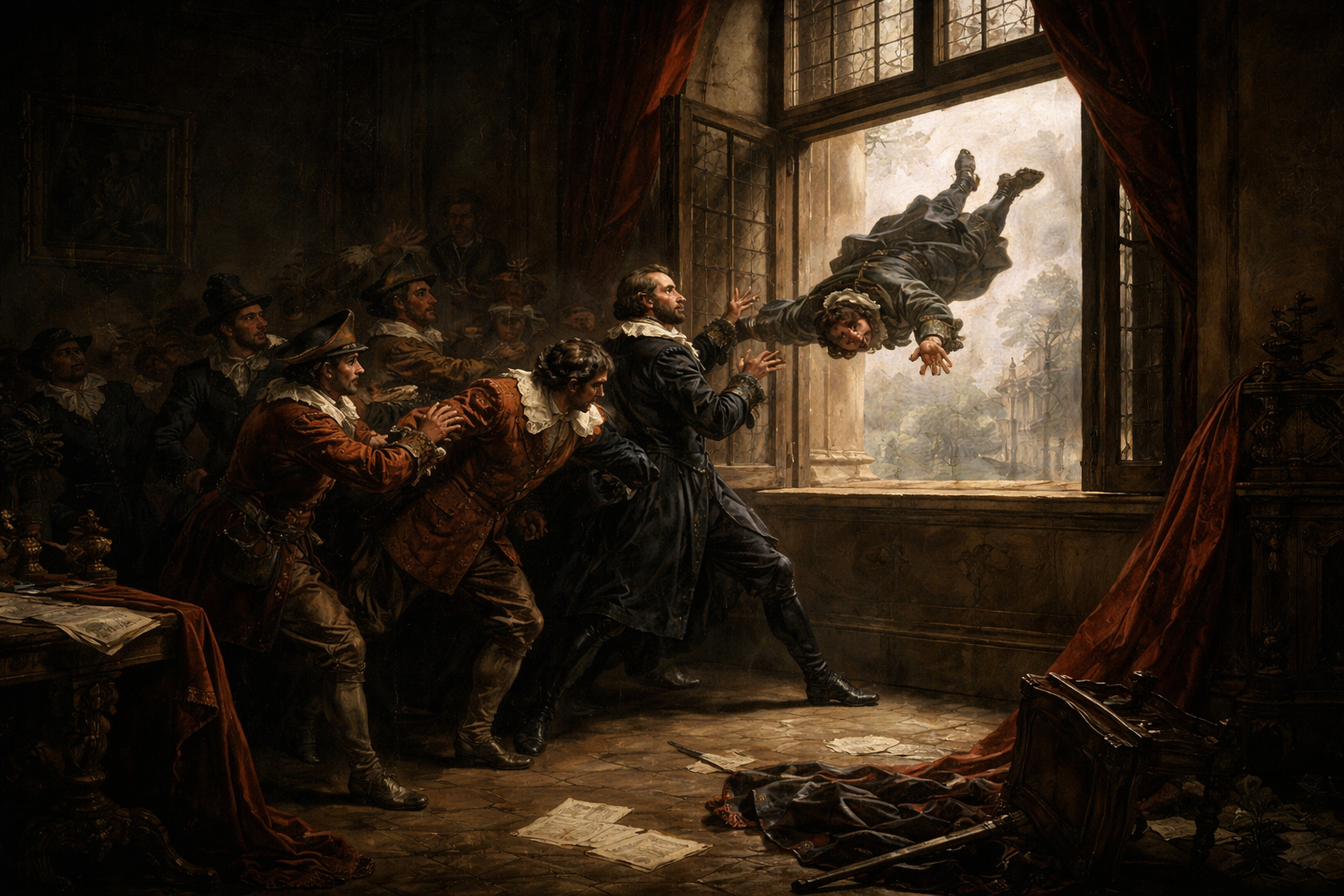
Cold air bled into the council chamber, carrying the damp breath of the Vltava below. The stone walls of Prague Castle had heard centuries of confession and cruelty, but this morning they listened harder.
Protestant nobles stormed Prague Castle, confronting two Catholic imperial governors, Vilém Slavata of Chlum and Jaroslav Bořita of Martinice. Both dressed in black coats and stiff collars, their faces pale as consecrated bone. Accusations heated as words flew like fireballs from both sides.
Slavata’s hands trembled against the table. Bořita clutched a rosary, the beads biting into his palm. Their secretary, Fabricius, stood near the window, listening as the talks exploded into argument.
“You have stolen what was promised,” one noble accused, his voice low, almost reverent. “You closed our churches. You strangled God in His own house.”
The governors protested. They always did. Something about the law, authority, and the emperor’s will. Each word rang hollow, swallowed by the silence pressing inward from the walls.
Since words had failed, as they always do, action was the last resort. Someone seized Bořita by the collar.
The room erupted—boots scraping, breath shattering, prayers breaking into screams. Fabricius cried out as he was dragged forward. The window thrust open. The frame biting into his ribs, with the two governors closely behind to suffer the same fate. For a moment, the world narrowed to sky and stone and the terrible understanding that history had chosen their bodies.
The fall was endless.
Air roared like a judgment. The castle vanished above them. Below, the courtyard waited, dark and reeking, a pit of refuse and rot. When they struck, the sound was not the crack of bone but the wet gasp of survival.
Above, the window stared down, unblinking.
Men crossed themselves. Others laughed, not with joy, but with the brittle hysteria of those who had finally shattered the order of things. Somewhere in the city, bells began to ring, not in warning, but in awakening.
Again, politics and religion collided. The impact was not debate but ruin, and Europe would burn because of a window used as a weapon.
THE CAUSE OF UNREST –
The Letter of Majesty of 1609 had promised protection to the Protestant nobles of Bohemia. To them, it was not just paper.
It was breath.
Before, their faith existed at the mercy of shifting crowns and whispered toleration. Churches stood only so long as emperors looked the other way. Worship was permitted, then withdrawn, then punished. Memory itself had learned to kneel.
This legally binding concession, forced from a weakened emperor, was the result of pressure. A promise of revolt by the armed Protestant estates. It granted freedom of worship for Lutherans and Calvinists.
They were given the right to build and control Protestant churches. A Protestant governing body, the Defensor’s, was created to protect these rights. They also received legal standing equal to Catholic institutions within Bohemia.
These inalienable liberties were anchored in law when it finally bore the emperor’s seal. To the Protestants, it felt like dawn breaking through a cathedral of stone.
The emperor’s name, Rudolf II, was pressed into wax, binding his authority to their survival. The words promised what sermons could not. They promised the right to gather without fear. People could raise steeples without apology. It meant teaching children a faith not hunted by night. For the first time, belief was anchored not in defiance, but in law.
And law, in that age, was the only shield against extinction.
The Letter did more than protect worship; it named the Protestants as legitimate. It placed them within the body of the kingdom rather than at its margins. It gave them Defensor’s guardians, empowered to stand watch against erasure. It told them they were no longer guests in their own land.
The betrayal cut deeply, inked assurances of tolerance and worship fragile as parchment held to flame. Yet above them loomed the ruling Hapsburg dynasty, unyielding and devoutly Catholic, its grip tightening with quiet menace. What had been granted in peace would be reclaimed in silence.
When Protestant chapels shuttered, doors barred, and altars darkened, the violation was unmistakable. These were not mere buildings sealed shut. Instead, faith was smothered and rights were strangled behind stone walls. Governors acted in the emperor’s name. It was the sound of a promise being strangled. The wax seal cracked. The oath bled out. Distrust festered. Fury ripened.
To lose the Letter meant returning to a world where faith survived only by hiding. In this world, prayers were whispered like crimes. The future belonged to whoever held the sword.
The protestants did not cling to the Letter out of idealism.
They clung to it because without it, history had already shown them what came next.
Fire.
Exile.
Graves without names.
The Letter of Majesty mattered because it was the thin trembling line between tolerated existence and annihilation. When that line was crossed, the world learned how loudly faith could scream when cornered.
In 1618, restraint shattered.
The defenestration was no accident of rage. It was a deliberate severing of obedience. Hurling a body through an opening meant to provide light was a message written in bone and air. With that fall, Bohemia rose in open rebellion against Habsburg authority, and the continent felt the tremor.
What followed was not war, but unraveling.
From 1618 to 1648, Europe burned in the Thirty Years’ War. Kingdoms bled, villages vanished, and entire generations erased by sword, starvation, and pestilence. Fields became graves. Faith became justification. Survival became chance.
Everything traced back to a single moment. Men chose gravity over governance. The world fell with them.
TIMELINE –
On the morning of May 23, 1618, Prague Castle awoke beneath a low, bruised sky. Inside its walls, the tension between Protestant and Catholic had fermented beyond repair.
The Letter of Majesty—once a promise of peace—lay in tatters, its guarantees trampled by imperial decree.
The Protestant nobles came armed not with blades, but with grievance.
They confronted the Emperor’s Catholic governors, Vilém Slavata of Chlum and Jaroslav Bořita of Martinice. They accused them of betraying Bohemia’s religious freedoms. Voices rose. Accusation sharpened. Law became a matter of interpretation. Faith became weapon.
Judgment was swift.
The governors were seized and dragged toward the window overlooking the castle moat. Their secretary, Filip Fabricius, was taken with them—guilt assigned by proximity. The window was flung open. The city waited below.
One by one, they were hurled into the void.
Seventy feet they fell, spinning through air thick with destiny. They struck the ground and lived, an outcome so improbable it became theology. Catholics spoke of angels. Protestants muttered about a landing softened by dung and refuse heaps. History recorded survival, but not mercy.
The act was more than violence. It was a declaration.
Within days, Bohemia was in open revolt. Within months, kings were chosen and rejected. Within years, the war spread like a plague across Europe. Villages erased, empires hollowed, and faith soaked in blood.
The Thirty Years’ War did not begin with a battle.
It began with a window, a fall, and the sound of a body refusing to die.
But this was not the first time, nor would it be the last.

1419 –
The Uproar of 1419 did not rise suddenly. It rotted into being. This open window ushered in an age of holy violence.
For years, Prague had lived beneath a low spiritual suffocation. The Church towered over the city like a mausoleum, rich with gold, while the streets below starved. Authority spoke in Latin and demanded silence. Obedience preached as salvation. Dissent was heresy, and heresy burned.
The smoke of Jan Hus still lingered.
Four years earlier, he had been betrayed, condemned, and reduced to ash at the stake. To Rome, his death was order restored. To Bohemia, it was a wound that would not close. Hus became more than a man; he became a grievance that whispered from pulpits and alleyways alike. His followers, the Hussite’s, carried his memory like a sharpened relic.
By the summer of 1419, the city trembled.
Preachers spoke passionately. They condemned corruption and excess. They criticized a church that fed upon the poor while promising heaven later. The people listened. Hunger sharpened faith. Faith sharpened rage.
On July 30, the bells of New Town Hall rang not in harmony. Instead, they rang in provocation. The streets filled with a procession led by the preacher Jan Želivský.
Voices chanting, banners raised, prayers twisted into demands. They marched to New Town Hall. They called for the release of imprisoned Hussite’s. Their words echoed against stone walls that had never answered mercy.
Outside, the crowd pressed together. Hussite followers, laborers, the faithful poor, faces hollowed by hunger and zeal. They had come for justice. They had come with scripture clenched like a blade.
Then, a stone fell from a window.
Whether thrown in malice or fear no longer mattered. The sound was enough. It struck the crowd like a verdict.
The doors were breached. The hall was invaded. The city councilors, Catholic men of law and privilege, were dragged from their chambers, pale and pleading. No court convened. No scripture was consulted. Judgment had already been written in blood.
The windows were opened.
Bodies were hurled into open air, robes flaring like dying wings. The crowd below surged, arms raised, not to catch but to receive. The fall was short. The end was not. Those who survived the fall met the mob below, where hands became weapons, and the cobblestone drank deeply.
When it was over, the windows stood empty, but Prague was changed forever.
The First Defenestration was not chaos. It was retribution. It was faith stripped of patience. It was the moment belief learned it could kill.
And once the city had tasted that power, there was no closing the window again.
Bohemia descended into the Hussite wars. Faith became a justification for slaughter and God’s name echoed through fire and siege. This was not rebellion. It was the birth of sacred violence.

1948 –
By 1948, the doors of Czechoslovakia had already been sealed. Only the windows remained.
Jan Masaryk moved through the halls of power like a man haunting his own life—the son of a founder. The echo of democracy already embalmed. Around him, the state was quietly being hollowed out. There were no drums. There were no barricades. There were only signatures, resignations, and the soft click of locks turning.
Jan Masaryk’s place in history comes at the end of a quiet, suffocating sequence of political strangulation. He was not a revolutionary. He was a bridge between two worlds.
His father, Tomáš Garrigue Masaryk, was the founder of democratic Czechoslovakia. A committed democrat, Jan tilted hard toward Soviet control. He was respected in the West, tolerated, but distrusted by communists.
In February, the communists did not seize power with violence. They withdrew, forcing the nation to collapse inward. Ministers resigned in unison, a choreographed absence that left the government bleeding. President Beneš, cornered and exhausted, accepted the resignations. In doing so, he handed the country to men who did not need tanks, only time.
Police forces changed allegiances overnight. Newspapers learned new truths. Dissent learned silence.
Masaryk remained.
He was the last voice that did not belong. A relic tolerated for appearances, dangerous for memory. He walked beneath portraits of his father, feeling the weight of inheritance curdle into warning. Friends vanished. Conversations ended mid-sentence. The walls listened.
He spoke of despair.
He spoke of being watched.
He spoke of feeling already dead.
On the night of March 9, the Černín Palace slept uneasily. Somewhere inside, a bathroom window stood open to the cold. In the early hours of March 10, Jan Masaryk’s body lay shattered below it. Barefoot, dressed for bed, and broken against the stone like something discarded.
The state spoke quickly.
Suicide.
The word was meant to close the matter, to bury doubt before it could breathe. But the details refused obedience. The fall did not fit the body. The body did not fit the window. The night did not fit the man.
Years later, when the regime’s grip finally loosened, the truth clawed its way back into light. Investigations reopened old wounds. Forensics whispered what witnesses had feared: Masaryk did not jump.
He was pushed.
No names were ever carved into the verdict. Power rarely leaves fingerprints. The window remained. The courtyard washed clean.
Jan Masaryk did not die because he chose to fall.
He died because, once again, history decided that silence was heavier than a body. Gravity would finish what politics began.
HISTORY REPEATS –
Prague’s windows are never just openings; they are thresholds. They watch. They wait.
Across centuries, the city has demonstrated resilience. From 1419 to 1618 to 1948, history shows that faith is often under extreme pressure. In such times, gravity ultimately decides the outcome. Law or conscience are also tested severely in these times.
It is not merely coincidence. The stones, the glass, and the cold air stand as witnesses. They observe a city whose walls remember betrayal and oppression. They also recall the failure of words.
Authority becomes fragile when promises are broken. Power becomes ruthless when dissent survives. Truth becomes dangerous when it threatens the convenient silence of rulers.
The defenestration is Prague’s grim liturgy: a ritual of warning, a communion of fear. The act itself is secondary.
What matters is the lesson etched into stone and air. Those who wield power may throw. However, those who are wronged may rise in fury. History will bear witness in the only way it knows—through bodies, through shock, through the echo of a fall.
In Prague, every open window is a reminder that justice, vengeance, and despair do not merely speak; they plunge. The city does not forget. The city does not forgive. And the windows never truly close.

Leave a Reply