
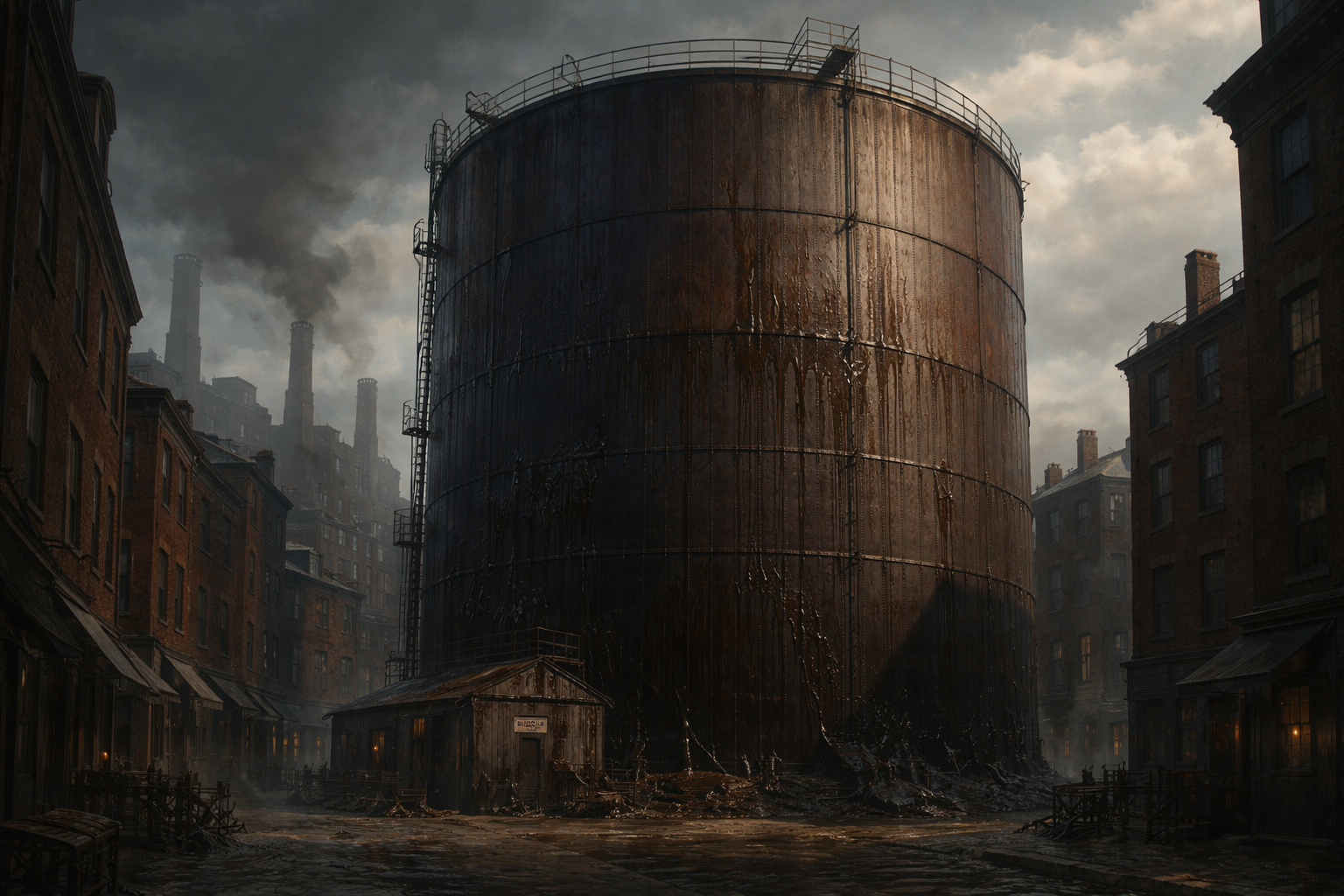
Boston was in the grip of a bitter cold snap, wrapped in iron frost. A fragile hint of sunshine stirred false hope among its residents. Smiles crept across numb faces thawed by the promise of relief after a long, oppressive winter.
It was mid-morning. An hour that should have belonged to light and renewal. Unaware that beneath the city’s quiet optimism, something dark was already beginning to stir.
On Wednesday, January 15, 1919, the streets of Boston’s North End throbbed with the restless pulse of a midweek morning. Carts rattling, voices rising, the machinery of ordinary life grinding forward without pause.
Near the great molasses tank, a woman paused at her window. A low, dreadful sound rolled through the avenues. A deep metallic growl. It echoed from its direction like the warning breath of some immense, imprisoned thing.
On the street below, workers forced another fresh shipment of molasses into the already wounded vessel. Its iron belly was swollen beyond reason. The woman shook her head, irritation dulling what should have been fear.
Resuming her chores, she turned her back on the monstrosity. There were meals to prepare, floors to sweep, and little time for unease. Soon her family would return from school and work, and the day, so deceptively ordinary, demanded completion. Unaware that the tank outside was already rehearsing its scream.
The tank had long been a source of unending trouble, its presence tolerated rather than trusted. Complaints about the integrity of the massive structure were repeatedly voiced.
However, they only fell upon deaf ears. Indifference and profit swallowed them. Molasses wept endlessly from its seams. It seeped into the streets and crept along cobblestones like a living stain. It trailed its sticky darkness into homes and workplaces alike.
Despite all its quiet violations, it was just an inconvenience. So far, it remained a nuisance dismissed. Its actual malice was still patiently waiting.
At times, the company that birthed the monstrosity dispatched a representative, a hollow gesture meant to resemble concern. They would arrive, inspect, and depart, leaving behind an illusion of remedy while the wound itself festered.
The repairs were cosmetic. Paint and patches laid over a failing skeleton. Never daring to confront the tank’s rotting integrity.
The residents continued their complaints. Their voices rose against steel and indifference alike. The company answered with band aids, content to let the danger breathe and wait.
At 12:40 pm, the tank found its voice, and it was louder than it had ever dared to be. This was not the familiar chorus of groans and weary creaks of settling metal. It was something far worse.
A deep gathering growl arose, low and furious, from within its iron body. Then came the cracks. Sharp, staccato reports as rivets failed one by one, snapping loose in frantic succession.
Those nearby threw themselves to the ground, certain they were under fire. The sound so violent it mimicked machine gun bursts ricocheting through the narrow North End streets, seeking an unseen victim.
Then the air split open with a thunderous roar. It felt like an unseen enemy had seized the tank, tearing at it with brutal intent. Iron was peeled apart by something enormous and impatient.
A mechanical scream followed, raw and unholy, chased by a roaring, advancing whoosh. Heavy, unstoppable, and terrifyingly alive.
In that instant, there was no time left to run, no breath left to understand. Fate had already been loosed, and it was rushing forward to claim its due.
The container that held the molasses finally gave way. Its collapse is sudden, absolute, and catastrophic. It was a terrifying failure, a symphony of industrial demise. The screaming iron, spitting steel, and the roar of containment violently undone.
Those caught in the wake of the thirty-foot wave of death were offered no mercy. Some drowned where they stood. Others suffocated as the syrup stole the air from their lungs. Many others were crushed beneath its hardening weight as it cooled and thickened around them.
The tsunami of dark sweetness moved at nearly thirty-five miles per hour. It tore through the North End with blind fury ravaging everything in its path.
Streets vanished beneath it, buildings buckled and collapsed, and rail cars wrenched from their tracks, hurled aside like children’s toys.
Proof that even the heaviest things can be made helpless when the city’s own sins come rushing back.

In the wake of devastation, the streets yielded their grim count. Twenty-one souls lost to the deathly current of sweetness, claimed by a flood that showed no mercy.
As evening fell, more than one hundred and fifty others bore their wounds. Bodies broken, lungs burned, lives forever altered by the weight of what should never have been unleashed.
This was the sorrowful harvest of a giant that refused to listen. Deaf to the warnings and pleas of the people living in its shadow. The tragedy did not arrive by fate alone: it was invited.
It could have been prevented had proper care been taken, had the integrity of the tank, swollen with 2.3 million gallons of molasses, been truly secured rather than carelessly assumed.
Instead of safeguarding lives, the company chose reassurance over responsibility. Placation over protection. Condemning a community to bloodless drowning and a city to a grief that still clings like a stain.
TIMELINE –
In 1915, at Boston’s North End, a massive steel storage tank was raised by The United States Industrial Alcohol Company (USIA). A looming presence of riveted iron and unchecked ambition.
It stood fifty feet tall and ninety feet wide, an industrial behemoth designed to imprison 2.3 million gallons of molasses within its thin metal skin.
From the beginning, the construction betrayed it. Poorly built and inadequately tested, the tank could not contain its contents. Molasses bleeds from its seams, oozing into the streets and slipping beneath doors. It creeps into homes and workplaces like a slow, sticky curse.
The residents took note, watching the dark syrup stain their cobblestones and walls. Unaware that these early leaks were not mere nuisances, but warnings whispered by a structure already preparing to fail.
Between 1916 and 1918, the tank was tended to in name only. Repairs were made, but only to its surface. Cosmetic gestures meant to quiet concern rather than confront decay.
No accurate tests were ever performed, no reckoning forced upon the steel shell that strained under its burden.
On warmer days, the structure betrayed itself. Loud groans and ominous rumblings rolled from its iron body. Metal laboring under pressure as if the tank itself were warning those within earshot of its growing unrest.
Yet the world was at war, and the demand for molasses swelled alongside the tank’s contents. Shipments increased, feeding the production of industrial alcohol for munitions. With each delivery, the burden grew heavier, until the warnings could no longer be contained.
On January 15, 1919, a fresh shipment of molasses was poured into the tank’s rigid depths. Its heat collided with the cold, sluggish mass already trapped inside.
The city, still bruised by winter, experienced an unnatural thaw as the temperature crept upward toward 40 degrees Fahrenheit. This coaxed pressure and fermentation alike to awaken.
Within the tank, the burden grew unbearable. The warming air and churning contents strained the already compromised iron shell. Swelling from within like a breath held too long.
What had endured through neglect and denial now stood at the brink, heavy with sweetness, heat, and consequence. One final insult away from catastrophe.
At 12:40 pm, the inevitable arrived. The tank, no longer capable of containing what it had been forced to bear, failed without mercy or warning. Its iron skin split open, and the molasses burst free.
A towering wave, thirty feet high, came rushing forth at an estimated thirty-five miles per hour. The dark, unstoppable surge unleashed upon the streets below.
Heavy syrup flooded the avenues, swallowing them whole. Buildings collapsed as if they were made of paper and rail cars were ripped from their tracks. In that single violent moment, the tank’s long, suppressed fury became the city’s undoing.
Boston learned what happens when warnings are ignored and containment is mistaken for control.
The aftermath revealed a grim accounting. Twenty-one innocents lay suffocated or crushed beneath the immense weight of the molasses. Their bodies trapped as the syrup thickened and hardened.
The day’s brief warmth surrendered once more to the winter chill by evening.
One hundred and fifty others were left injured. Marked by bruises, broken bones, and memories that would never loosen their grip.
The community rallied in the face of horror. Neighbors, firefighters, police, and sailors labored side by side. Clawing at the sticky wreckage in desperate attempts to free the living and recover the dead.
But the debris fought back, a formidable enemy that clung, dragged, and refused to let go. Saltwater, sand, and fire hoses were thrown against the mess, yet the work stretched on for weeks.
The molasses did not stay contained to the North End. It was tracked through the city. Smeared into streets and homes, carried on shoes and wheels far beyond the site of the collapse.
Even as summer crept closer, the sickly-sweet stench lingered in Boston’s air.
The harbor bore witness as dark brown waters finally rushed out to sea. Carrying with them the last traces of a disaster that refused to be forgotten.
Between 1920 and 1925, the reckoning arrived in slow, grinding fashion. More than one hundred families rose against the USIA, their grief carried into courtrooms heavy with accusations and memory. The civil battle dragged on, long and unforgiving, mirroring the suffering that had brought it into being.
In the end, responsibility could no longer be denied. The company was found liable. Compensation was granted.
Not as restoration, for nothing could return what had been taken, but as an acknowledgment of culpability. Eternally etched into the legal record.
From the wreckage of the tragedy came an uneasy resolve. Those entrusted with industrial safety were forced to listen at last.
Stricter building codes were enforced, engineering oversight was made mandatory, and standards across the United States were strengthened.
Lessons written not in ink, but in iron, molasses, and the lives lost beneath both.
