
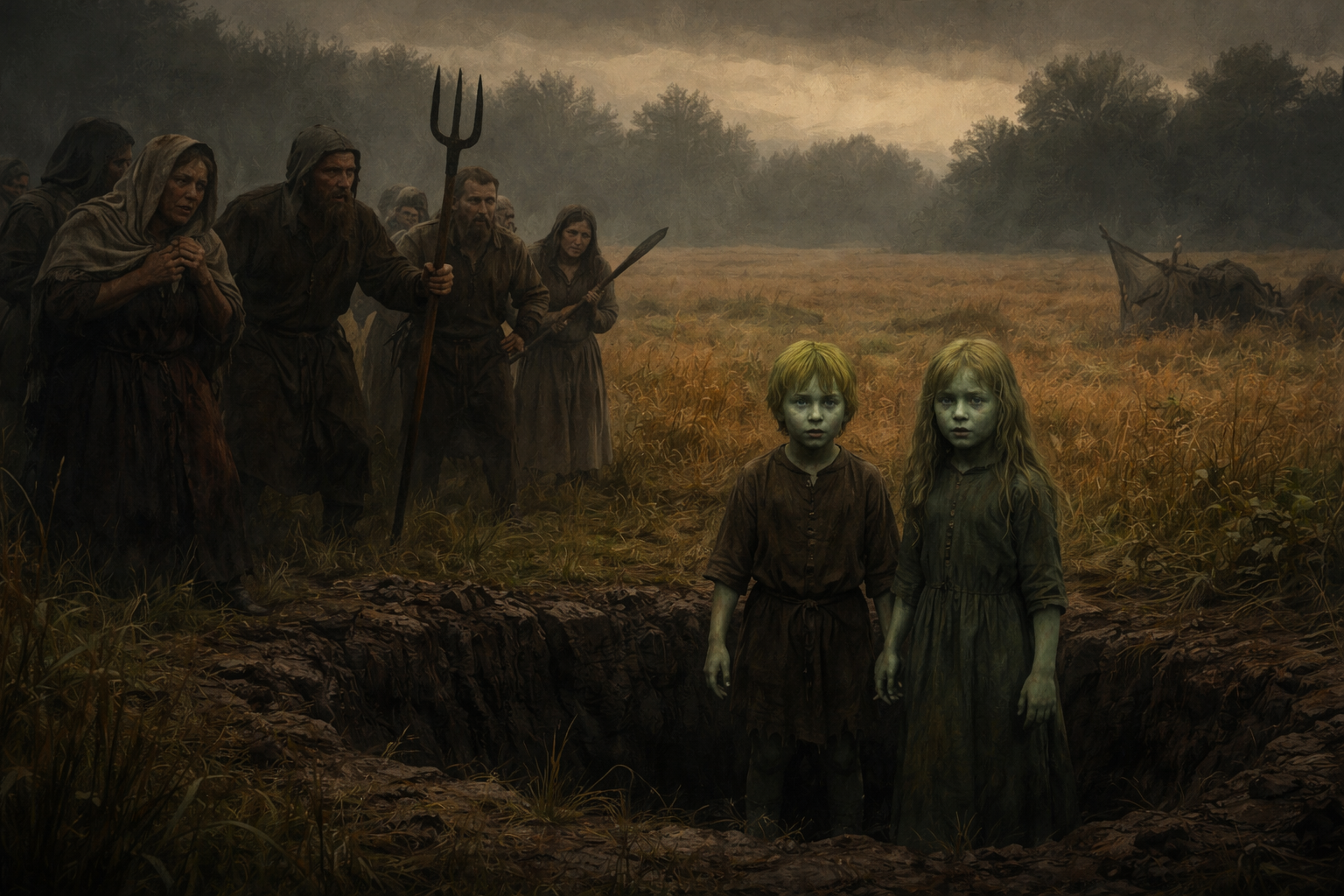
In the fields outside Woolpit, the wolf pits yawned like open mouths in the soil.The harvest had just begun to rot beneath a sunless sky. The villagers would later swear the air had felt wrong that day. Too still, too hushed, as though the land itself were holding its breath.
That was when the children appeared.
They emerged not from the road, not the woods, but from the ground’s own wounded throat. Standing at the edge of a pit meant for beasts. A boy and a girl. Small. Silent. Watching.
Their skin was the color of bruised leaves left too long in shadow.
No prayer prepared the villagers for that green pallor nor the way the children’s eyes reflected no sky. Remnants of something dim and distant haunted their gaze. They spoke in a tongue no one recognized. Soft, lilting sounds that curled like roots through soil.
When offered bread and meat, they recoiled in terror. Only raw beans, still wet with earth, did they clutch to their mouths with desperate hands.
They were taken in, watched closely, whispered about. Crosses were drawn. Doors barred at night.
The boy weakened quickly. His body, never meant for this world, failed him. Baptized in holy water that hissed faintly against his skin. He passed soon after, eyes wide, staring past the priest, past the church, past the world itself.
The girl lived.
Time stripped the green from her skin as it strips moss from stone, but it never touched her eyes. When she learned to speak, her words chilled those who listened.
She told them of St. Martin’s Land. A place of eternal dusk, where the sun was a rumor, and everything grew in shades of green. A world beneath this one. A place where bells rang without churches. Where children wandered too close to cavern mouths that breathed like living things.
She spoke of a sound that called to them, gentle and irresistible. It lead them through dark passages until the earth spat them out into blinding light.
She never smiled when she spoke of it.
The villagers wanted explanations. They wanted safety. They wanted God to make sense of it all. But some things, once unearthed, refuse to be buried again.
The girl vanished into obscurity. Some say she married, though to whom no one would agree. Still the fields of Woolpit remained uneasy. Crops failed without reason. Livestock refused to graze near the old pits. Children recounted dreaming of bells tolling beneath their beds.
And on certain nights, when the moon is thin and the ground is wet, the soil still seems to breathe.
As if St. Martin’s Land has not forgotten the way back.
As if the earth is waiting.
THE HISTORY BEHIND THE LEGEND –
Between 1130 and 1150, England was a land under omen. Trembling beneath famine, civil war, and divine anxiety during the reign of King Stephen.
The countryside of Suffolk grows uneasy. Fields fail, skies dim, and superstition rules the soil. Wolf pits are dug deep into the earth for protection, mouths prepared to swallow predators…or worse.
Villagers working the fields near Woolpit encountered two children standing beside a wolf pit. They are not injured, yet not entirely human in appearance. Their skin bears a sickly green hue, as though the ground itself has stained them. They speak no known language. Their clothes resemble no local make.
Fear spreads faster than reason.
The children refused all food, wasting away as villagers debated whether they were cursed, fae, or demonic.
Only raw bread beans, still smelling of dirt and rot, are accepted. Whispers of witchcraft and ill omen trail them wherever they are kept.
The children are taken into the household of Sir Richard de Calne. Over time, they are coaxed into eating bread and cooked food. As their diet changes, so does their flesh. The green fades slowly, unnaturally, like moss drying in sunlight.

The boy weakens rapidly. He is baptized into the church, though some accounts suggest the holy rite brings no peace. He dies soon after. His small body can’t survive in this world. His death is quietly mourned and quickly buried.
The girl endures. She learns English. She listens. She remembers.
When questioned, she speaks of St Martin’s Land. A place of eternal twilight, a world without actual sun, a land where everything living or dead is green.
She recalls bells ringing in the darkness and wandering through cavernous passages before emerging into this world.
The girl is baptized and eventually absorbed into English society. Some records claim she married; others imply she never entirely belonged.
In the late 12th to early 13th century, chronicles were recorded by William of Newburgh and Ralph of Coggeshall. They preserved the tale in Latin.
They record it not as myth, but as uneasy history. Something seen, not explained. Each recorded them decades after the supposed event, which makes them valuable but historically ambiguous.
Centuries later, doubt, mockery, and reinterpretation among scholars led to debates. Were the children lost immigrants, had they been malnourished or affected by illness, or was folklore mistaken for fact?
Others whispered darker possibilities of other worlds, buried realms, doors beneath the earth.
Woolpit remains marked by the story. The pits are gone, but the ground remembers. The tale survives because it resists certainty, a truth smothered by time, still breathing beneath legend.
Legends endure because they cling to something real, something half-seen, half-remembered, and never fully explained. The Green Children of Woolpit linger not as a fairy tale, but as a fracture in history. Truth has slipped underground and learned to whisper.
Dwelling in the shadows where folklore is layered over fact like soil over bone. The past refuses to stay buried. Some stories are not meant to be solved, only uncovered, again and again, each time revealing a darker shape beneath.

Leave a Reply